
Feelings & Friendships: Help Children Name Big Feelings Through Story Characters
Developed with child psychologists, this journal uses book characters as gentle mirrors for worry, anger, jealousy, and bravery. Give your child a safe, shame-free vocabulary to understand their inner world.
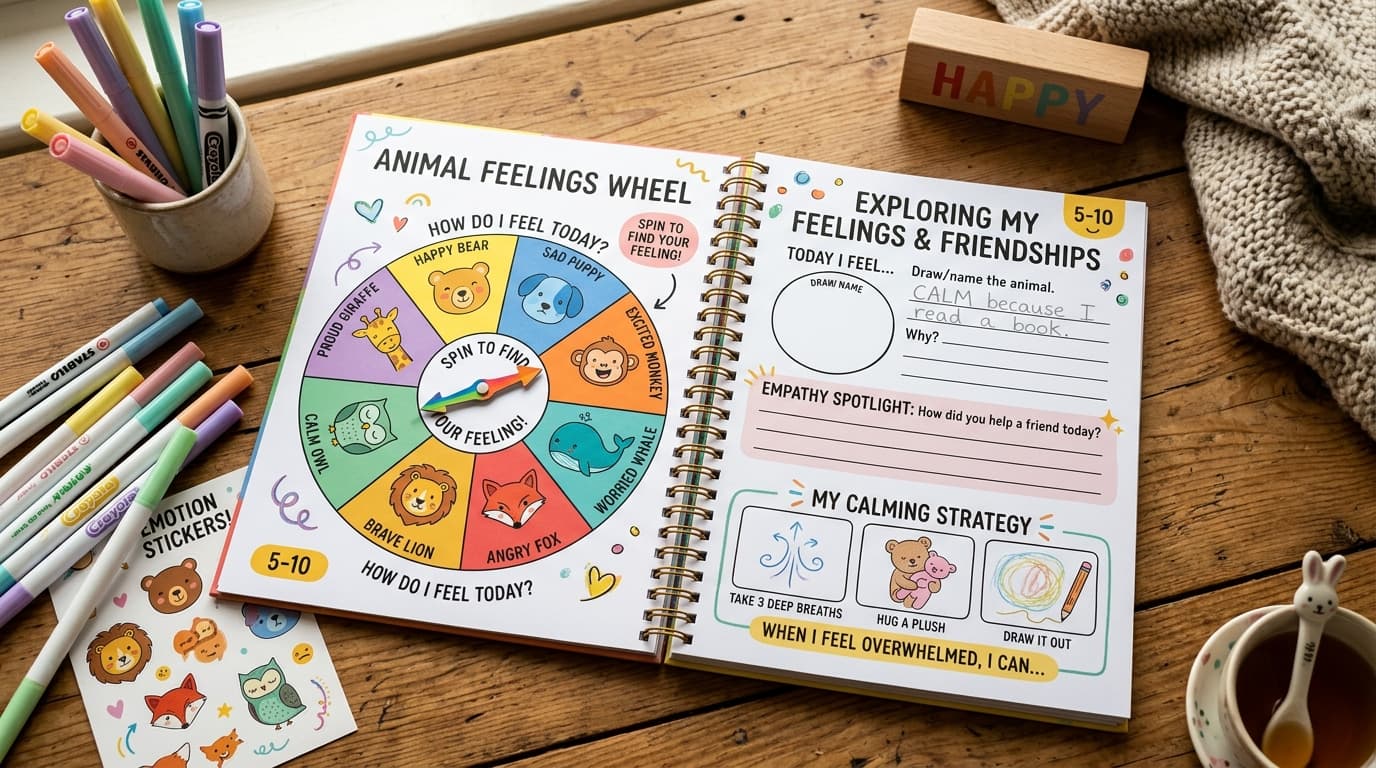
What is the Feelings & Friendships Social-Emotional Journal?
The Feelings & Friendships Social-Emotional Journal is a free printable literacy and emotional wellness workbook for children ages 5 to 10. Built upon Dr. Dan Siegel's “Name It to Tame It” neuroscience principle, it provides children with a safe psychological mirror: rather than putting kids on the spot about their own tantrums or anxieties, it invites them to analyze book characters first. Using an Animal Feelings Wheel, empathy spotlight prompts, and calming regulation toolkits, children develop the emotional vocabulary needed to resolve conflicts, express needs peacefully, and reduce behavioral outbursts.
Why Families & Educators Love This Journal
Children don't misbehave because they want to; they act out when their feelings outgrow their vocabulary. Here is how this journal bridges the gap:
Animal Feelings Wheel
Features kid-friendly animal expressions (Worried Whale, Angry Fox, Calm Owl) so children can easily point to their feeling even when verbalizing feels hard.
Empathy Spotlight Prompts
Questions like “How would you help Whale feel calm?”build cognitive empathy, helping children imagine someone else's perspective.
Reduces Outbursts
Providing nuanced emotional words (impatient, disappointed, overwhelmed) allows children to name their state before it erupts into frustration or tears.
Safe, Private Sanctuary
A tender bedtime reflection space between parent and child—free from criticism, grading, or school pressure.
Sample After-Story Questions Inside the Log
These carefully framed prompts gently encourage children to reflect on characters and discover parallels in their own daily lives:
Parent Guideline: There are no wrong answers. When your child answers, validate them first: “That makes so much sense why Whale felt that way.”
“When Fox got impatient, what helped him wait?”
Focuses on impulse control and delay of gratification. Opens up a discussion about what our bodies and hands can do when waiting feels hard.
“Have you ever felt a small worry grow big like Whale's tide?”
Normalizes anxiety by showing that even massive creatures like whales feel worried. Invites children to share their “small worries” before bedtime.
“What kind words can we give someone who made a mistake?”
Fosters forgiveness, social grace, and resilience. Reminds children that mistakes are how brains grow—both in books and at school.
“Draw what bravery looked like in tonight's chapter.”
Redefines bravery away from fighting monsters toward emotional courage: asking for help, standing up for a friend, or trying something after failing.
The Science of “Name It to Tame It”
Why storytelling is the most effective medium for teaching children emotional regulation.
Pioneered by UCLA clinical professor of psychiatry Dr. Daniel Siegel (author of The Whole-Brain Child), the “Name It to Tame It” principle explains that when a child experiences intense fear, anger, or frustration, the right hemisphere of the brain and the emotional amygdala take over.
“When children can name their emotions and tell the story of what happened, the left hemisphere of the brain connects with the right. The prefrontal cortex engages, calming the nervous system and restoring emotional equilibrium.”
By using characters as gentle third-party mirrors, children explore complex feelings (jealousy, exclusion, performance anxiety) without defensive resistance. They witness characters struggle, seek help, and resolve problems—providing subconscious blueprints for their own lives.
The 3-Step Bedtime Social-Emotional Ritual:
Identify Character's Emotion
Find the animal feeling icon that matches how the character felt during tonight's chapter.
The Personal Bridge
Ask: “When is a time you felt that same way?” Listen without fixing or lecturing.
The Calming Strategy
Pick one calming tool (Whale Breaths or Volcano Doodle) to soothe the feeling before bedtime.
The 8 Animal Feelings Inside the Wheel
Tap on an animal archetype to see what it feels like in a child's body and how to support them.
Joyful, Warm, Content
Body Cue: Smiling, heart feels light, ready to share smiles
Anxious, Overwhelmed
Body Cue: Butterflies in stomach, heavy deep waters, needs reassurance
Frustrated, Impatient
Body Cue: Jaw tight, fists clenched, feeling treated unfairly
Courageous, Determined
Body Cue: Heart beating fast but trying anyway, standing up tall
Peaceful, Thoughtful
Body Cue: Quiet breathing, listening carefully, rested mind
Disappointed, Lonely
Body Cue: Tears, heavy shoulders, wanting a soft cuddle or blanket
Accomplished, Confident
Body Cue: Standing tall after working hard, celebrating a win
Eager, Full of Energy
Body Cue: Bouncing, talking fast, eager for what comes next
The 3 Whale Breaths Strategy
1. Hand on Belly: Place one hand on your tummy like a whale floating on the calm sea.
2. Inhale Deeply: Breathe in through your nose for 4 seconds, feeling your tummy expand like a gentle wave.
3. Exhale Slowly: Blow out smoothly through your mouth for 5 seconds like a misty whale spout.
💡 Pediatric Note: Prolonged exhalation activates the parasympathetic vagal nerve, naturally slowing heart rate.
The 4-Part Sincere Apology
1. Name the Action:“I am sorry for taking your book without asking.”
2. Acknowledge Feeling:“I know that made you feel upset and frustrated.”
3. Make It Right:“Here is your book, and can I help you find your page?”
4. Future Promise:“Next time I will ask first and wait for your answer.”
💡 Social Script:Teaches restorative accountability instead of forced, hollow “sorry” words.
About This Social-Emotional Resource
Frequently Asked Questions
Everything you need to know about using story characters for emotional literacy and calming.
Give Your Child the Gift of Emotional Safety
Download the complete printable PDF now. Free instant access—no login, no credit cards, and ready to print for home, homeschool, or classroom use.